
After implementing a numeracy intervention program, the next important step is to document what was done, what results were observed, what challenges were encountered, and what recommendations should be considered for improvement.
To help teachers prepare a clearer and more organized report, EduFilesPH is sharing this free Accomplishment and Narrative Report on Numeracy Program in editable Word format. This sample report may be used as a guide in documenting RMA-based numeracy interventions, learner progress, and school-based numeracy program implementation.
This report is useful for teachers, Mathematics coordinators, class advisers, school heads, and PMES focal persons who need a ready-to-edit format for preparing accomplishment reports, narrative reports, and portfolio documentation.
Please remember that this file is only a sample template. Teachers should customize the content based on their actual Rapid Mathematics Assessment results, learner data, school action plan, intervention schedule, monitoring records, and school reporting requirements.
About This Numeracy Program Report Sample
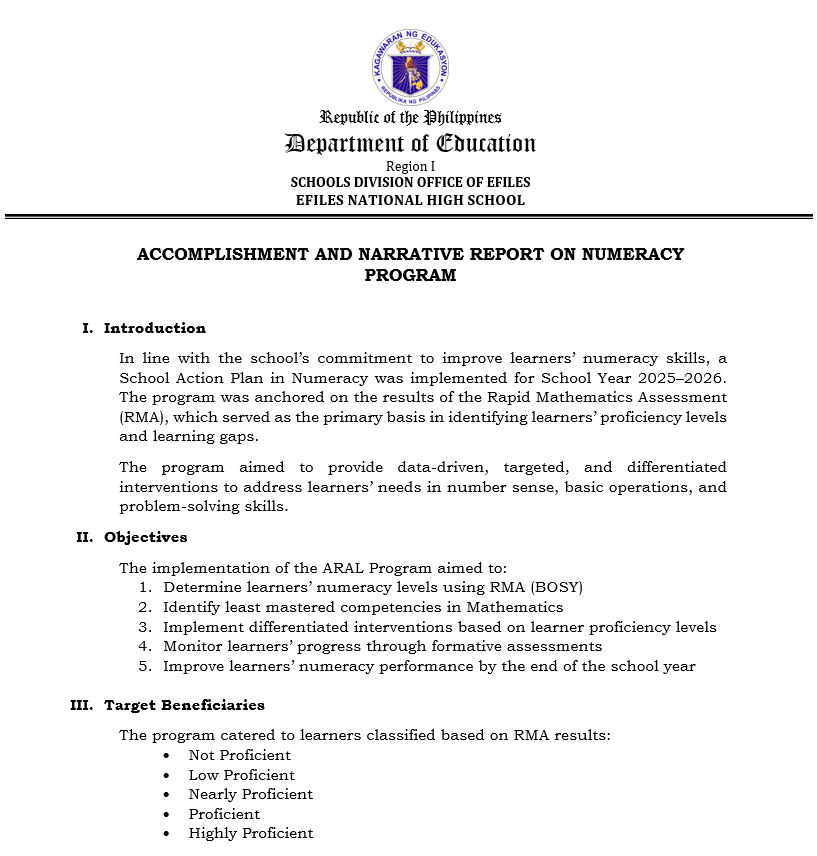
This Accomplishment and Narrative Report on Numeracy Program is designed to help teachers document the implementation of a school-based numeracy intervention program.
The sample report includes important sections such as:
- introduction;
- objectives;
- target beneficiaries;
- basis of the program;
- assessment and identification;
- planning and development of intervention;
- implementation of differentiated strategies;
- monitoring and evaluation;
- accomplishments;
- narrative of implementation;
- results and findings;
- challenges encountered;
- recommendations;
- conclusion;
- signatories; and
- documentation section.
Instead of starting from a blank document, teachers may use this sample as a guide and revise the content based on their actual class, grade level, learner needs, and school context.
What Is a Numeracy Program Report?
A Numeracy Program Report is a formal document that describes how a teacher or school implemented a numeracy support program for learners who need help in Mathematics.
It explains:
- why the program was implemented;
- what assessment data was used;
- who the target learners were;
- what numeracy skills needed support;
- what intervention strategies were applied;
- how learner progress was monitored;
- what improvements were observed;
- what challenges were encountered; and
- what recommendations should be made for the next implementation.
This type of report helps show that the numeracy program was properly planned, implemented, monitored, and evaluated.
Why This Report Matters
Many teachers already conduct remediation and intervention activities in Mathematics, but documentation can be challenging.
A numeracy report helps teachers:
- organize RMA results into a formal report;
- show evidence of learner improvement;
- document intervention strategies used;
- present accomplishments clearly;
- identify remaining learning gaps;
- provide evidence for school-based monitoring;
- prepare PMES or portfolio documentation;
- support future numeracy planning; and
- show that learner progress was monitored properly.
A strong report does not only list activities. It explains how data was used, what actions were taken, and what results were observed.
RMA as the Foundation of the Report
This sample report is anchored on the Rapid Mathematics Assessment, or RMA.
RMA may be used to:
- identify learners’ numeracy levels;
- determine learners who need intervention;
- detect learning gaps in Mathematics;
- identify least mastered competencies;
- guide differentiated intervention strategies;
- monitor learner progress; and
- compare Beginning of School Year and End of School Year results.
When writing your report, it is best to include actual RMA data so the report becomes evidence-based and not just activity-based.
Learner Numeracy Levels
The sample report groups learners based on RMA proficiency levels.
Learners may be classified as:
| Numeracy Level | Suggested Focus |
|---|---|
| Not Proficient | Intensive remediation and foundational numeracy support |
| Low Proficient | Guided practice, drills, and basic operations support |
| Nearly Proficient | Problem-solving practice and guided math activities |
| Proficient | Enrichment and application tasks |
| Highly Proficient | Advanced problem-solving and peer tutoring roles |
This grouping helps teachers plan appropriate activities for learners with different needs.
Objectives of the Numeracy Program
The sample report includes objectives that may guide the implementation of the numeracy program.
The program may aim to:
- determine learners’ numeracy levels using RMA results;
- identify least mastered competencies in Mathematics;
- implement differentiated interventions based on learner proficiency levels;
- improve learners’ number sense, basic operations, and problem-solving skills;
- monitor learner progress through formative assessments;
- increase learner participation and confidence in Mathematics; and
- improve overall numeracy performance by the end of the school year.
Teachers may revise these objectives depending on their actual school action plan and learner needs.
Target Beneficiaries
The target beneficiaries are learners identified through RMA results as needing numeracy support.
The report may include:
- grade level;
- section;
- number of learners served;
- learners classified as Not Proficient;
- learners classified as Low Proficient;
- learners classified as Nearly Proficient;
- learners classified as Proficient;
- learners classified as Highly Proficient; and
- learners needing focused support in specific competencies.
For stronger documentation, teachers should include actual numbers instead of leaving the section blank.
Program Implementation
The report may present the implementation of the numeracy program in several parts.
Assessment and Identification
The implementation begins with the administration of the RMA pre-test or Beginning of School Year assessment.
This helps teachers identify:
- learners’ current numeracy level;
- least mastered competencies;
- learners needing intensive remediation;
- learners who need guided practice;
- learners ready for enrichment; and
- specific areas for intervention.
The consolidated results are then used as basis for planning numeracy activities.
Planning and Development of Interventions
After reviewing the RMA results, teachers may group learners according to proficiency level and identify the specific competencies that need support.
Common numeracy focus areas may include:
- number sense;
- basic operations;
- place value;
- fractions;
- problem-solving;
- mathematical reasoning;
- word problems;
- measurement; and
- application of basic math skills.
Teachers may then prepare activities based on the identified needs of each learner group.
Implementation of Differentiated Strategies
A numeracy intervention program becomes more effective when the activities are matched with learner needs.
The sample report includes differentiated strategies for each proficiency group.
| Learner Group | Suggested Intervention Strategies |
|---|---|
| Not Proficient | Intensive remediation, CRA approach, one-on-one support, small group sessions |
| Low Proficient | Guided practice, basic operations drills, use of manipulatives, repeated exercises |
| Nearly Proficient | Problem-solving strategies, guided math activities, peer support |
| Proficient | Enrichment tasks, application activities, independent practice |
| Highly Proficient | Advanced problem-solving, challenge tasks, peer tutoring roles |
This approach helps ensure that learners receive the type of support that matches their current level.
The CRA Approach in Numeracy Intervention
The CRA approach may be useful for learners who need intensive support in Mathematics.
CRA stands for:
| Stage | Meaning | Example |
|---|---|---|
| Concrete | Learners use actual objects or manipulatives | counters, blocks, sticks, number cards |
| Representational | Learners use drawings or visual models | number lines, pictures, diagrams |
| Abstract | Learners use numbers and symbols | equations, operations, written solutions |
This approach helps learners move from hands-on understanding to symbolic mathematical thinking.
Schedule of Activities
The sample report includes an implementation schedule that teachers may revise based on their school calendar.
A possible schedule may look like this:
| Period | Activity |
|---|---|
| June 2025 | RMA Pre-Test and planning |
| July 2025 to March 2026 | Numeracy intervention and monitoring |
| March 2026 | RMA Post-Test or EOSY assessment |
Teachers should update the dates based on their actual program implementation.
Resources Utilized
The sample report may include the instructional materials and tools used during the numeracy program.
Possible resources include:
- RMA tools and test forms;
- manipulatives;
- flashcards;
- worksheets;
- modules;
- activity sheets;
- number cards;
- digital resources;
- problem-solving worksheets;
- performance tasks; and
- learner progress monitoring sheets.
Including the resources used helps make the report more complete and easier to validate.
Monitoring and Evaluation
A good accomplishment report should show how learner progress was monitored.
The sample report may include monitoring tools such as:
- pre-test and post-test assessments;
- weekly tracking;
- monthly tracking;
- class records;
- performance logs;
- formative assessments;
- activity outputs;
- teacher observations;
- learner progress sheets; and
- feedback from teachers or parents.
Monitoring and evaluation help show whether the intervention activities are working and whether adjustments are needed.
Accomplishments of the Numeracy Program
The accomplishment section summarizes what was achieved during the implementation.
Possible accomplishments may include:
- successful administration of RMA pre-test and post-test;
- consolidation of RMA results;
- identification of learners needing numeracy support;
- development of differentiated intervention plans;
- implementation of targeted numeracy activities;
- improved learner participation;
- increased learner confidence in Mathematics;
- enhanced numeracy skills in basic operations;
- improved problem-solving performance; and
- documented learner progress through monitoring tools.
Teachers should include actual data, numbers, or percentages whenever available.
Narrative of Implementation
The narrative section explains how the program was carried out.
A sample narrative may discuss:
- the initial numeracy difficulties observed among learners;
- how RMA results were used to identify learning gaps;
- how teachers grouped learners based on proficiency levels;
- what remediation strategies were implemented;
- how hands-on materials and visual aids were used;
- how learners participated in activities;
- how parents supported home-based numeracy tasks;
- how learner confidence improved over time; and
- how monitoring helped guide adjustments.
This section makes the report more meaningful because it tells the story behind the data.
Results and Findings
The results section should show the impact of the intervention program.
Based on the sample report, possible results may include:
- increased number of learners moving to Proficient and Highly Proficient levels;
- decreased number of learners under Not Proficient and Low Proficient levels;
- improved performance in number sense;
- improved performance in basic operations;
- improved problem-solving skills;
- better learner participation in Mathematics activities;
- increased confidence in answering math tasks; and
- improved engagement during remediation sessions.
For a stronger report, teachers may include a simple comparison table.
| Indicator | BOSY / Pre-Test | EOSY / Post-Test |
|---|---|---|
| Not Proficient | Insert number | Insert number |
| Low Proficient | Insert number | Insert number |
| Nearly Proficient | Insert number | Insert number |
| Proficient | Insert number | Insert number |
| Highly Proficient | Insert number | Insert number |
This table helps readers quickly see the movement of learners from one level to another.
Challenges Encountered
The report should also mention the challenges encountered during implementation.
Possible challenges include:
- limited time for remediation sessions;
- irregular attendance of some learners;
- insufficient materials for some activities;
- varied pacing and learning abilities of learners;
- limited home support for some learners;
- difficulty scheduling intervention sessions;
- interruptions due to school activities; and
- lack of enough printed worksheets or manipulatives.
Including challenges makes the report realistic and helps guide future planning.
Recommendations
The recommendation section should suggest ways to improve or sustain the numeracy program.
Possible recommendations include:
- continue and strengthen the numeracy intervention program;
- provide additional instructional materials and resources;
- enhance parent involvement in home-based numeracy activities;
- allocate more time for remediation sessions;
- conduct regular RMA-based monitoring;
- prepare more differentiated worksheets;
- create small group remediation schedules;
- provide additional support for Not Proficient and Low Proficient learners;
- sustain monitoring and evaluation practices; and
- use the results as basis for the next school action plan in numeracy.
Recommendations should be realistic and connected to the findings of the report.
Suggested Report Structure
Teachers may follow this structure when preparing their own report:
- School Header
- Report Title
- Introduction
- Objectives
- Target Beneficiaries
- Basis of the Program
- Program Implementation
- Assessment and Identification
- Planning and Development of Interventions
- Implementation of Differentiated Strategies
- Schedule of Activities
- Resources Utilized
- Monitoring and Evaluation
- Accomplishments
- Narrative of Implementation
- Results and Findings
- Challenges Encountered
- Recommendations
- Conclusion
- Prepared by / Noted by
- Documentation
This structure helps make the report complete, organized, and easier to review.
How to Use the Editable Numeracy Report Sample
- Download the editable Word file from the download section.
- Open the file using Microsoft Word.
- Save a backup copy before editing.
- Replace the sample school name and school details.
- Update the school year and implementation dates.
- Encode the actual number of learners served.
- Add the grade level and section.
- Insert your actual RMA pre-test data.
- Revise the target beneficiaries based on your class results.
- Edit the intervention strategies used.
- Add monitoring and evaluation details.
- Insert RMA post-test results or EOSY findings.
- Revise the challenges and recommendations.
- Add names and positions of the preparer and approving personnel.
- Insert documentation photos if required.
- Review the final report before printing or submitting.
Important Editing Reminders
Before submitting the report, check all details carefully.
Review the following:
- school name;
- school year;
- implementation period;
- number of learners served;
- grade and section;
- RMA pre-test results;
- RMA post-test results;
- learner proficiency levels;
- intervention strategies;
- monitoring tools;
- accomplishments;
- findings;
- challenges;
- recommendations;
- signatories;
- documentation photos; and
- formatting.
Do not submit the sample report without editing it. The report should reflect your actual numeracy program implementation.
PMES and Portfolio Use
This Numeracy Program Report may be useful as supporting documentation for PMES or teacher portfolio preparation.
It may support evidence related to:
- learner assessment data;
- developed numeracy intervention plan;
- implemented intervention program;
- monitoring and evaluation of learner progress;
- differentiated instruction;
- remediation and learner support;
- documentation of accomplishments; and
- school-based numeracy program implementation.
Teachers should still check the specific MOV requirements given by their school, rater, or PMES focal person.
Teacher Tip
Use real data to make your report stronger. A good numeracy report should include both the story of implementation and the evidence of learner progress.
You may include:
- RMA BOSY result;
- RMA EOSY result;
- number of learners per proficiency level;
- sample intervention schedule;
- monitoring sheets;
- learner outputs;
- photos of intervention activities;
- summary of learner movement; and
- teacher observations.
This makes the report more useful, more credible, and easier to validate.
Preview of the Report
Below is a preview of the Accomplishment and Narrative Report on Numeracy Program.
Important Reminder
This Accomplishment and Narrative Report on Numeracy Program is shared to help teachers prepare numeracy documentation more conveniently. Please review and revise the content before using it for school submission or portfolio purposes.
If your school, district, division, or region provides a required format, please follow the official format.
Please do not repost, resell, or claim this template as your own. You may share the official EduFilesPH post link instead so other teachers can access the original source.
Frequently Asked Questions
Is this Numeracy Program Report free?
Yes. This post provides a free editable Accomplishment and Narrative Report on Numeracy Program for teachers.
What file format is the report?
The report is provided in editable Word format.
What is the basis of the report?
The report may be based on Rapid Mathematics Assessment results, learner progress monitoring, and the implementation of a school action plan in numeracy.
Can I edit the school name and report content?
Yes. You can edit the school name, teacher name, school year, intervention period, learner data, findings, recommendations, and signatories.
What is RMA?
RMA means Rapid Mathematics Assessment. It may be used to identify learners’ numeracy levels, learning gaps, and progress in Mathematics.
What learner groups are included in the report?
The sample report may include learners classified as Not Proficient, Low Proficient, Nearly Proficient, Proficient, and Highly Proficient.
What intervention strategies are included?
The report may include strategies such as CRA approach, one-on-one sessions, small group remediation, guided practice, drills, use of manipulatives, problem-solving activities, enrichment tasks, and peer tutoring.
Can this be used for PMES?
Yes. It may be used as supporting documentation or MOV if it matches the required indicator, objective, and school instructions.
Can this be used as a final report?
Yes, but only after editing. Teachers should customize the report based on their actual RMA results, learner data, intervention activities, and program outcomes.
Should I include actual learner data?
You may include summarized data such as number of learners per proficiency level. Avoid exposing sensitive learner information unless your school requires it and proper privacy safeguards are followed.
Should I include documentation photos?
Yes, if required by your school. Documentation photos may help support the report, but make sure to follow school policies on learner privacy and photo use.
Is this an official DepEd template?
No. This is not an official DepEd-issued template. It is an editable sample report created to help teachers prepare numeracy intervention documentation.
What should I do if I find an error in the template?
Please message or contact EduFilesPH so we can review and update the file if needed.
Related Resources
You may also check these related EduFilesPH resources:
- School Action Plan in Numeracy
- Mathematics Action Plan
- Automated Test Result Analysis Template
- Summary of Grades Template with Ranking and Awardee Indicator
- Reading Intervention Report Sample
- Reading Remedial and Intervention Plan
- PMES Portfolio Templates SY 2025–2026
- E-SAT Completion Certificate Template
Download the Free Numeracy Program Report Sample

Disclaimer
EduFilesPH shares educational templates and resources to help teachers and school personnel. The files are provided as supplementary tools and should be used with proper checking and school guidance.
Users are advised to validate all details, learner data, assessment results, findings, and recommendations according to their school’s official policies and requirements. EduFilesPH is not officially affiliated with the Department of Education unless clearly stated. Always follow official school, district, division, or regional instructions when preparing numeracy program reports, PMES MOVs, or teacher portfolio documents.