
Many teachers conduct reading assessments but still face one common challenge: how to turn the results into a clear, organized, and usable intervention plan.
This Free Editable Reading Remedial and Intervention Plan Word Template is designed to help teachers document reading needs, plan appropriate remediation activities, monitor learner progress, and prepare evidence for school reading programs or PMES-related documentation.
The template is especially useful after conducting reading assessments such as Phil-IRI, where learners may be identified as independent, instructional, frustration-level readers, or non-readers. Instead of simply listing learners with reading difficulties, this plan helps teachers organize the next steps: what intervention to give, how often to implement it, who will be involved, and how progress will be monitored.
About This Reading Remedial and Intervention Plan
A reading remedial or intervention plan is a structured document that guides teachers in supporting learners who need help in decoding, fluency, vocabulary, and comprehension.
This template helps teachers move from assessment results to actual classroom action. It includes sections for learner profile, identified reading needs, intervention strategies, implementation schedule, monitoring tools, post-assessment, and success indicators.
DepEd Order No. 14, s. 2018 states that Phil-IRI is a classroom-based assessment tool used to describe learners’ reading performance in oral reading, silent reading, and listening comprehension. It also identifies independent, instructional, and frustration reading levels. The same issuance notes that Phil-IRI data may serve as one basis for planning or redesigning reading instruction and school reading programs.
Because of this, a reading intervention plan becomes more useful when it is based on actual learner data instead of general assumptions. Teachers can use the results to group learners, choose appropriate activities, and document progress over time.
Why Teachers Need a Reading Intervention Plan
After checking the reading level of learners, teachers need a practical plan that answers these questions:
- Who needs reading support?
- What specific reading skills need to be improved?
- What strategies are appropriate for each group of learners?
- How often will the intervention be conducted?
- How will the teacher monitor progress?
- What evidence can be prepared after implementation?
Without a written plan, reading intervention may become inconsistent. A documented plan helps ensure that activities are organized, measurable, and easier to review by the teacher, reading coordinator, or school head.
DepEd Basis and Alignment
This resource is aligned with the purpose of using reading assessment data for planning reading instruction. Under DepEd Order No. 14, s. 2018, Phil-IRI data may be used as a basis in planning, designing, or redesigning reading instruction and school reading programs.
The template may also support school-level academic recovery or remediation efforts when used together with actual learner assessment data, school reading program targets, and monitoring records. DepEd also issued DO 018, s. 2025 for the Academic Recovery and Accessible Learning Program, which may be relevant for schools organizing structured support for learners needing additional academic assistance.
Important: This template is not an official DepEd form. It is an editable teacher-made resource that may be customized based on the school’s required format, reading program, and division instructions.
What’s Included in the Template
The editable Word file includes the following major parts:
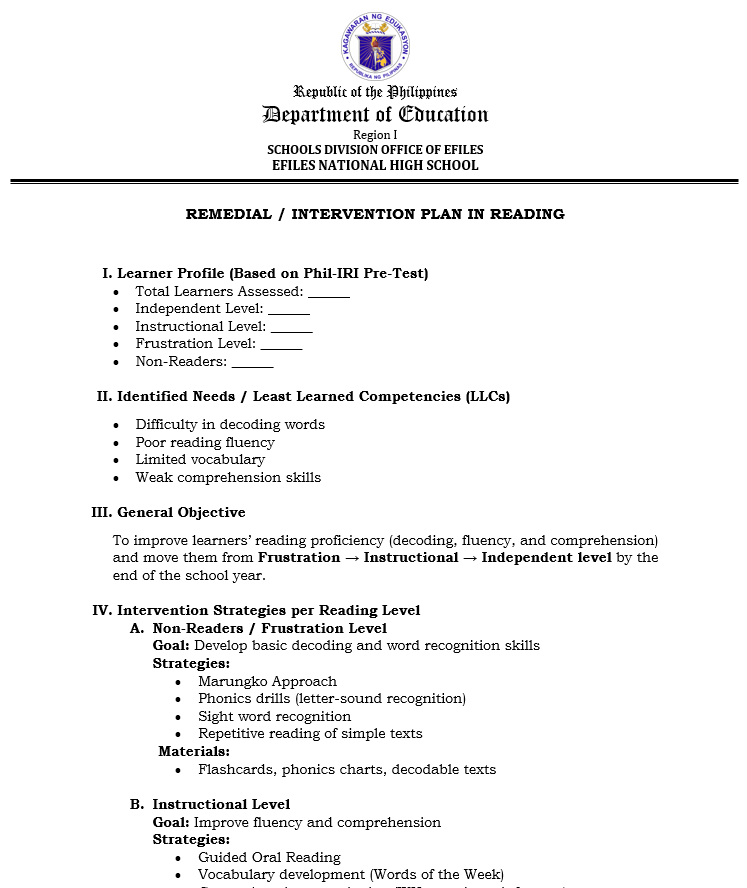
1. Learner Profile Based on Phil-IRI Pre-Test
This section allows the teacher to summarize the number of learners assessed and classify them according to reading level.
It includes spaces for:
- Total learners assessed
- Independent level readers
- Instructional level readers
- Frustration level readers
- Non-readers
This section helps provide a clear starting point before intervention begins.
2. Identified Reading Needs or Least Learned Competencies
The template includes common reading needs such as:
- Difficulty in decoding words
- Poor reading fluency
- Limited vocabulary
- Weak comprehension skills
Teachers may revise this part based on actual assessment results, classroom observations, and learner outputs.
3. General Objective
The plan includes an objective focused on improving learners’ reading proficiency in decoding, fluency, and comprehension.
The goal is to help learners progress from frustration level to instructional level, and eventually to independent level when possible.
4. Intervention Strategies Per Reading Level
The template groups strategies according to learner needs.
For non-readers or frustration-level readers, the plan may include:
- Marungko Approach
- Phonics drills
- Letter-sound recognition
- Sight word recognition
- Repetitive reading of simple texts
For instructional-level readers, the plan may include:
- Guided oral reading
- Vocabulary development
- WH questions
- Inference questions
- Partner reading
- Assisted reading
For independent-level readers, the plan may include:
- Silent reading activities
- Book talks
- Reading journals
- Independent comprehension tasks
This makes the plan more differentiated instead of giving the same activity to all learners.
5. Implementation Plan
The implementation plan helps teachers organize the frequency of intervention activities and identify the persons involved.
Sample activities may include:
| Activity | Suggested Frequency | Persons Involved |
|---|---|---|
| Remedial Reading Sessions | 3–5 times per week | Teacher, learners |
| Guided Reading | Daily or as scheduled | Teacher |
| Home Reading Program | Weekly | Parents, learners |
| Reading Log Monitoring | Weekly | Teacher, parents |
| Monthly Reading Assessment | Monthly | Teacher, reading coordinator |
Teachers may adjust the schedule depending on class program, available time, learner needs, and school reading priorities.
6. Monitoring and Evaluation
Monitoring is important because reading intervention should not stop at conducting activities. Teachers also need to check whether learners are improving.
The template suggests using:
- Class record or reading log
- Monthly reading assessment
- Oral reading checks
- Progress monitoring sheet
- Intervention adjustment notes
This section helps teachers document the progress of learners and decide whether the current intervention should continue, be modified, or be intensified.
7. Post-Assessment
The post-assessment section helps teachers compare learner performance before and after the intervention.
Teachers may use this section to document:
- Phil-IRI post-test results
- Pre-test and post-test comparison
- Progress of learners by reading level
- Accomplishment report data
This is useful for school reading program evaluation and portfolio documentation.
8. Success Indicators
The template includes success indicators such as:
- Increased number of learners in instructional and independent levels
- Improved reading fluency and comprehension
- Documented learner progress
- Completed reading intervention records
These indicators help show whether the intervention produced measurable improvement.
Key Features of This Template
This Reading Remedial and Intervention Plan is helpful because it is:
- Editable in Microsoft Word
- Easy to customize for school context
- Based on learner reading assessment results
- Organized by reading level
- Useful for classroom remediation
- Helpful for reading coordinators and school heads
- Suitable as supporting documentation for implemented reading intervention
- Practical for PMES or school portfolio preparation, when aligned with actual implementation
How to Use the Reading Remedial and Intervention Plan
Follow these simple steps:
Step 1: Review Your Reading Assessment Results
Start with your available reading assessment data. Identify how many learners are independent, instructional, frustration-level readers, or non-readers.
Step 2: Identify the Main Reading Needs
Check the common difficulties among learners. Some may struggle with decoding, while others may need support in fluency, vocabulary, or comprehension.
Step 3: Group Learners According to Need
Group learners based on their reading level or specific reading difficulty. This allows you to give more appropriate activities.
Step 4: Choose Intervention Strategies
Select reading activities that match the learners’ needs. Non-readers may need phonics and word recognition activities, while instructional-level readers may benefit from guided reading and comprehension questions.
Step 5: Set a Realistic Schedule
Write how often the intervention will be conducted. For many learners, short but consistent reading sessions are better than irregular long sessions.
Step 6: Monitor Learner Progress
Use reading logs, oral reading checks, monthly assessments, and observation notes. Monitoring helps you decide whether the intervention is working.
Step 7: Conduct Post-Assessment
After the intervention period, conduct a post-assessment and compare the results with the pre-test data.
Step 8: Prepare Documentation
Keep copies of the plan, reading logs, progress records, assessment results, photos if allowed, and accomplishment reports. These may serve as supporting documents for school monitoring or PMES-related portfolios.
Practical Tips for Teachers
Here are some reminders when implementing the plan:
- Use actual learner data, not estimated numbers.
- Keep reading groups manageable.
- Start with simple and achievable activities.
- Use age-appropriate reading materials.
- Coordinate with parents or guardians for home reading tasks.
- Monitor progress regularly.
- Avoid comparing learners publicly.
- Protect learner information when preparing documentation.
- Revise the plan when the intervention is not producing improvement.
Sample Reading Intervention Activities
Here are sample activities you may include in your implementation plan.
| Learner Group | Reading Need | Suggested Activity | Monitoring Tool |
|---|---|---|---|
| Non-readers | Letter-sound recognition | Phonics drills, Marungko activities, flashcards | Oral reading checklist |
| Frustration-level readers | Decoding and word recognition | Repetitive reading, sight words, guided oral reading | Reading log |
| Instructional-level readers | Fluency and comprehension | Guided reading, vocabulary words, WH questions | Comprehension checklist |
| Independent readers | Deeper comprehension | Silent reading, reading journal, book talk | Journal review or rubric |
This table may be recreated in a WordPress Table block or added as a screenshot preview from the actual template.
PMES and MOV Documentation Use
This resource may be useful for teachers preparing documentation for reading intervention activities. When properly accomplished, the plan may support evidence such as:
- Developed reading intervention plan
- Implemented remediation activities
- Learner progress monitoring records
- Pre-test and post-test comparison
- Accomplishment report
- Photos or documentation of reading sessions, if allowed by school policy
However, teachers should still follow the specific PMES, RPMS, school, district, or division requirements applicable to them. Use this template as a support document, not as a replacement for official forms or required MOVs.
Preview of the Template
Important Reminders Before Using the Template
Before downloading and using the file, please remember:
- Edit the school name, region, division, and signatories.
- Replace sample names with your actual school personnel only if appropriate.
- Use actual reading assessment results.
- Do not include sensitive learner information in public posts or shared previews.
- Follow your school’s required format if there is an existing template.
- Let your school head, reading coordinator, or master teacher review the plan when needed.
- Keep supporting documents such as reading logs and assessment records.
Frequently Asked Questions
What is a Reading Remedial and Intervention Plan?
A Reading Remedial and Intervention Plan is a written plan that outlines how a teacher or school will support learners who need help in reading. It usually includes learner data, reading needs, intervention strategies, schedule of activities, monitoring tools, and post-assessment.
Is this template editable?
Yes. The file is an editable Word document. Teachers may revise the school information, learner profile, strategies, schedule, signatories, and other parts of the plan.
Can this be used after Phil-IRI?
Yes. This template is useful after Phil-IRI or other reading assessments because it helps teachers organize the results and plan appropriate reading interventions.
Can this be used for PMES documentation?
It may be used as supporting documentation if it matches the actual reading intervention implemented by the teacher or school. Always check your school, district, or division requirements for specific MOVs.
What reading levels are covered in the plan?
The template includes intervention ideas for non-readers, frustration-level readers, instructional-level readers, and independent readers.
How often should reading intervention be conducted?
The frequency depends on learner needs and class schedule. The template suggests activities such as remedial reading sessions, guided reading, home reading tasks, reading log monitoring, and monthly assessment.
Can I use this for Filipino or English reading?
Yes. The structure may be used for either Filipino or English reading intervention. Just customize the reading materials, activities, and assessment results based on the language and grade level.
Is this an official DepEd form?
No. This is a teacher-made editable template. It is designed to help teachers prepare a structured reading intervention plan, but it should be customized according to official school or division instructions.
Related Resources
You may also check these related EduFilesPH resources:
- Free Editable Reading Action Plan
- Free Editable Filipino Reading Action Plan
- Reading Intervention Report Sample
- Automated Test Result Analysis Template
- PMES Portfolio Templates
These resources can help you prepare a more complete set of reading program documents, from planning to monitoring and reporting.
Download the Free Editable Reading Remedial and Intervention Plan
You may download the editable Word file and customize it based on your class data, school reading program, and learner needs.

Final Notes
Reading intervention becomes more effective when it is based on real learner needs, implemented consistently, and monitored properly.
This editable Reading Remedial and Intervention Plan can help teachers organize their reading support activities and document learner progress in a more systematic way. Use it as a starting point, then adjust the content based on your learners, school program, and available reading materials.
Every learner’s reading progress may take time, but with consistent support, proper monitoring, and appropriate intervention, improvement becomes more visible and easier to document.
Disclaimer
This resource is a teacher-made template created to help fellow educators prepare reading intervention documents. It is not an official DepEd form and does not replace any required school, district, division, regional, or national template.
Teachers are encouraged to review, edit, and validate the content based on their actual learner data, school context, and current DepEd issuances. EduFilesPH does not claim ownership of official DepEd policies, logos, or forms. This file is shared for educational support purposes only.