
A School Action Plan in Science helps teachers, coordinators, and school personnel organize activities that support scientific inquiry, observation skills, experimentation, environmental awareness, learner participation, and Science-related school programs.
For SY 2026–2027, Science teachers may need an editable action plan that can guide classroom-based activities, laboratory or hands-on tasks, Science Club activities, investigatory projects, environmental campaigns, science exhibits, and learner output monitoring.
This editable School Action Plan in Science with Science Club activities is prepared to help teachers save time in planning. It may be used as a guide, but the content should still be reviewed, revised, and customized based on the learners’ needs, grade level, available materials, school facilities, safety considerations, and actual implementation schedule.
Resource Information
Resource Type: School Action Plan
Learning Area: Science
School Year: SY 2026–2027
File Format: Editable Word file
Recommended Users: Science teachers, Science coordinators, Science Club advisers, department heads, school heads, and school program coordinators
Main Use: Planning Science activities, inquiry-based learning, Science Club programs, learner outputs, monitoring, and documentation
Included Activities: Experiments, Science Club activities, STEM-related tasks, investigatory projects, environmental awareness, science exhibits, and school-based Science programs
About This School Action Plan in Science
The School Action Plan in Science for SY 2026–2027 is designed as a ready-to-edit planning guide for teachers handling Science and Science-related school activities. It provides a structured format for organizing objectives, activities, timelines, persons involved, resources needed, expected outputs, success indicators, and monitoring strategies.
This template may help Science teachers prepare a more organized plan for classroom investigations, simple experiments, Science Club activities, environmental campaigns, STEM-related tasks, learner exhibits, and documentation of Science learning activities.
The action plan should not be submitted without review. Teachers are encouraged to revise the content based on the school calendar, learners’ actual needs, available materials, laboratory or classroom facilities, safety reminders, and approved school programs.
Why This Science Action Plan May Be Useful
Science encourages learners to observe, ask questions, investigate, explain ideas, solve problems, and connect classroom learning to real-life situations. A clear action plan helps teachers organize these activities in a practical and manageable way.
A Science action plan may help teachers:
- organize Science learning area activities for the school year;
- plan hands-on activities, experiments, and inquiry-based tasks;
- support Science Club programs and learner participation;
- prepare activities for environmental awareness and school campaigns;
- guide learners in simple investigatory or STEM-related projects;
- identify needed materials, equipment, venues, and persons involved;
- promote safety during Science-related activities;
- monitor learner participation and outputs;
- prepare documentation for reports and MOVs; and
- align Science activities with the school calendar and school priorities.
What’s Included in the Template?
The editable School Action Plan in Science may include the following parts:
- title of the action plan;
- school year and learning area;
- rationale or brief background;
- general and specific objectives;
- target learners or participants;
- proposed activities and strategies;
- timeline of implementation;
- persons involved;
- resources needed;
- expected outputs;
- success indicators;
- monitoring and evaluation section; and
- remarks or documentation notes.
Suggested Activities for Science
The activities in the template may be edited depending on the grade level, school calendar, available materials, facilities, and school context. Some possible Science-related activities include:
- diagnostic checking of learners’ Science skills and needs;
- classroom-based Science inquiry activities;
- simple experiments and demonstrations;
- observation and recording activities;
- Science vocabulary-building activities;
- laboratory or hands-on activity orientation;
- safety reminders for Science activities;
- Science Club organization and planning;
- environmental awareness campaign;
- waste segregation or cleanliness campaign;
- school garden or nature observation activities when applicable;
- STEM-related classroom tasks;
- simple investigatory project activities;
- poster-making or infographic activities about Science concepts;
- Science quiz bee or review activities;
- Science exhibit or learner output display;
- participation in Science Month or related school activities when applicable;
- monitoring of learner outputs and participation; and
- preparation of accomplishment reports and documentation.
Three-Term Implementation Guide
This action plan may be adjusted depending on the school calendar and actual implementation schedule. Below is a simple guide for organizing Science activities across three terms.
Term 1: Orientation, Safety, and Initial Science Activities
During the first term, teachers may focus on orienting learners about Science class routines, safety reminders, classroom expectations, and basic inquiry skills.
Possible Term 1 activities may include:
- orientation on Science classroom rules and safety reminders;
- checking of available Science materials and resources;
- review of learners’ prior Science knowledge;
- simple observation and recording activities;
- introduction to inquiry-based learning tasks;
- Science vocabulary activities;
- initial Science Club planning when applicable; and
- documentation of initial learner outputs.
Term 2: Inquiry Activities, Science Club Programs, and Project Development
During the second term, teachers may focus on strengthening learners’ inquiry skills through hands-on activities, Science Club participation, environmental activities, and simple project-based tasks.
Possible Term 2 activities may include:
- simple experiments and demonstrations;
- group investigation activities;
- Science Club meetings or activities;
- environmental awareness campaign;
- Science-related poster or infographic activities;
- STEM-related activities;
- investigatory project planning when applicable;
- monitoring of learner outputs and participation; and
- documentation of completed activities.
Term 3: Output Presentation, Evaluation, and Reporting
During the third term, teachers may focus on checking learner progress, completing Science outputs, preparing documentation, and evaluating Science-related activities.
Possible Term 3 activities may include:
- completion of Science projects or learner outputs;
- presentation or exhibit of Science-related outputs;
- follow-up Science activities or enrichment tasks;
- checking of learner participation and progress;
- Science Club accomplishment reporting;
- preparation of documentation and MOVs;
- accomplishment report preparation; and
- recommendations for future Science activities.
How to Use This Template
- Download the editable file from the download section.
- Open the file using Microsoft Word or any compatible document editor.
- Review the sample content carefully before editing.
- Replace the school name, grade level, dates, names, and other sample details.
- Check the actual Science learning needs of your learners.
- Review the available materials, equipment, facilities, and safety requirements.
- Revise the objectives based on your Science learning area priorities.
- Edit the activities based on your school calendar and implementation schedule.
- Adjust the timeline according to the three-term schedule or actual school plan.
- Check the expected outputs, success indicators, and monitoring activities.
- Review safety reminders, especially for experiments, demonstrations, and outdoor activities.
- Proofread the final version before printing, submitting, or sharing.
Teacher Tip
Use this template as a guide, not as a final document. A good Science action plan should be realistic, safe, and connected to the actual learning needs of the students.
Before finalizing the file, check available materials, learner readiness, classroom space, laboratory resources, safety reminders, and school-approved activities. This helps make the action plan practical and easier to implement.
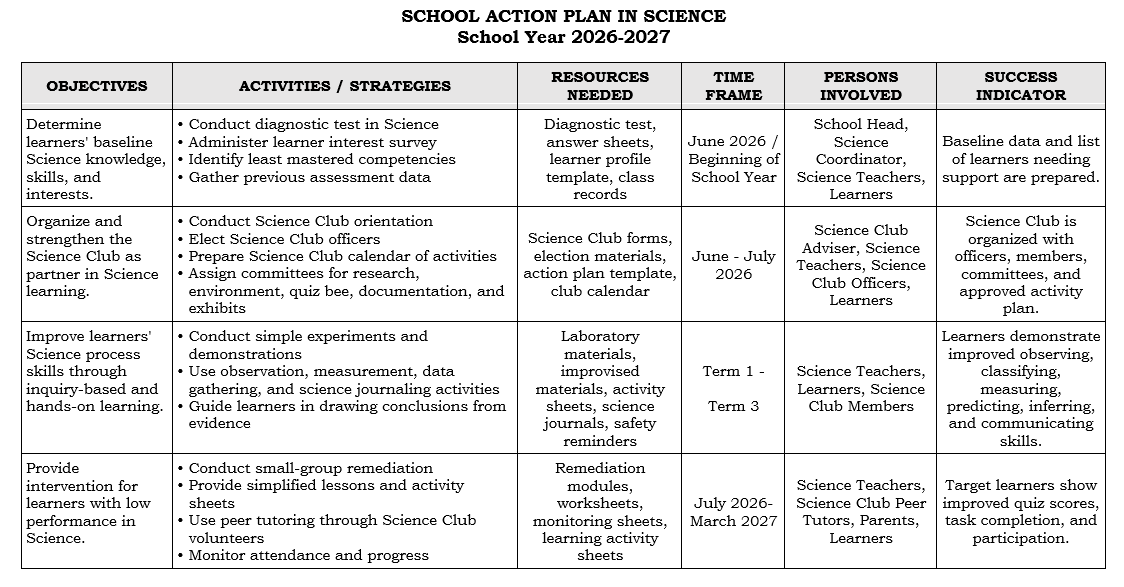
Preview of the File
Below is a preview of the editable School Action Plan in Science template. The actual file may contain additional sections, tables, or editable parts depending on the final version provided.
Important Reminder
This School Action Plan in Science is shared to help teachers save time in preparing planning documents. Please review, edit, and customize the file before using it.
Do not submit the template without checking the objectives, activities, timeline, persons involved, resources needed, expected outputs, and safety considerations. Make sure the final version matches your school context, learner needs, available resources, and actual implementation plan.
Please do not repost, resell, or claim this file as your own. You may share the official EduFilesPH post link instead so other teachers can access the original source.
Frequently Asked Questions
Is this School Action Plan in Science editable?
Yes. The file is editable and may be revised based on your grade level, school calendar, learner needs, available materials, facilities, and school priorities.
Can I use this for SY 2026–2027?
Yes. The template is prepared for SY 2026–2027. However, please review the dates, activities, and timeline before using it.
Is this ready for submission?
No. This is a template and sample guide only. Teachers should customize the content before submitting it to the school head, department head, coordinator, or concerned office.
Can I add Science Club activities?
Yes. You may add Science Club meetings, environmental campaigns, learner projects, Science exhibits, STEM tasks, or other school-approved activities.
Can I include experiments and hands-on activities?
Yes. You may include experiments, demonstrations, and hands-on activities, but always check safety reminders, available materials, supervision, and school guidelines before implementation.
Can this be used for elementary and junior high school?
Yes. The template may be used as a guide for different grade levels, but the activities should be adjusted based on the learners’ age, grade level, curriculum focus, and available resources.
Can I add investigatory project activities?
Yes. You may include simple investigatory project activities or STEM-related tasks if they are appropriate for the grade level and school context.
Can I share this file with other teachers?
You may share the official EduFilesPH post link. Please do not repost, resell, or claim the file as your own.
Related Resources
You may also check these related EduFilesPH action plan resources:
- School Action Plans SY 2026–2027
- School Action Plan in Mathematics SY 2026–2027
- School Action Plan in ICT SY 2026–2027
- School Action Plan in TLE SY 2026–2027
- School Action Plan in MAPEH SY 2026–2027
- School Action Plan in English SY 2026–2027
Download the School Action Plan in Science
You may download the editable School Action Plan in Science with Science Club Activities for SY 2026–2027 using the button below. Please make sure to review and customize the file before using it in your school.

Disclaimer
EduFilesPH shares educational templates and resources to help teachers and school personnel. The files are provided as editable guides and should be reviewed and customized before use.
EduFilesPH is not officially affiliated with the Department of Education unless clearly stated. Always refer to official DepEd issuances, school instructions, curriculum guides, safety reminders, and division or regional guidelines when preparing official documents.