
A clear and organized Action Plan in Reading helps teachers, reading coordinators, and school heads plan meaningful reading interventions for learners who need additional support.
For SY 2025–2026, EduFilesPH is sharing a free editable Action Plan in Reading based on Phil-IRI assessment results. This template is designed to help schools identify learners’ reading levels, plan appropriate interventions, monitor progress, and evaluate the effectiveness of the reading program.
The file is prepared in editable Word format, so teachers may revise the school details, activities, time frame, persons involved, and success indicators based on their school context.
Please remember that this template is a support resource only. Teachers and schools should still follow their school reading program, School Improvement Plan, division instructions, and other official guidance when preparing reading intervention plans.
Resource Information
Resource Type: Action Plan Template
Subject / Program Area: Reading
File Format: Editable Word file
School Year: SY 2025–2026
Main Basis: Phil-IRI assessment results
Main Use: Planning, implementing, monitoring, and evaluating reading interventions
Recommended Users: Teachers, reading coordinators, school heads, master teachers, and school reading program teams
About This Action Plan in Reading
This Action Plan in Reading is designed to help schools prepare structured reading interventions for learners based on assessment results.
The template includes action plan parts such as:
- objectives;
- activities and strategies;
- resources needed;
- time frame;
- persons involved; and
- success indicators.
These sections help teachers organize the reading program from assessment to intervention, monitoring, and evaluation.
Why an Action Plan in Reading Is Important
Reading is one of the most important foundational skills in basic education. A learner who struggles in reading may also experience difficulty in understanding lessons across different learning areas.
A reading action plan helps schools respond to this need in a more organized way. Instead of giving random reading activities, teachers can use assessment results to identify learners who need support and prepare targeted activities based on their reading level.
A good reading action plan may help teachers:
- identify learners’ current reading levels;
- group learners based on needs;
- plan appropriate reading interventions;
- assign persons involved in the program;
- prepare reading materials and monitoring tools;
- track learners’ progress;
- strengthen parent involvement;
- document school-based reading activities; and
- evaluate if the intervention improved learner performance.
Phil-IRI as Basis for Reading Intervention
The Philippine Informal Reading Inventory, commonly known as Phil-IRI, is used by schools to assess learners’ reading performance and identify reading levels.
Using Phil-IRI results, teachers can classify learners according to their reading performance and provide appropriate support.
Common reading levels include:
- Independent Level;
- Instructional Level; and
- Frustration Level.
The action plan also considers learners who may be non-readers or slow readers so that they can be given focused reading support.
What’s Included in the Template?
The editable Action Plan in Reading includes the following major parts:
Objectives
The template includes objectives such as:
- determining learners’ reading levels using Phil-IRI;
- analyzing Phil-IRI results;
- planning reading interventions;
- improving decoding, fluency, and comprehension;
- strengthening reading support at home;
- tracking learner progress; and
- evaluating the effectiveness of reading interventions.
Activities and Strategies
The template includes suggested activities such as:
- conducting Phil-IRI pre-test and post-test;
- classifying learners based on reading level;
- identifying non-readers and slow readers;
- organizing learners by reading need;
- preparing individualized or group reading plans;
- conducting monthly reading assessments;
- monitoring learner progress; and
- preparing accomplishment reports.
Reading Intervention Strategies
The template includes intervention strategies for different learner needs.
For learners at the non-reader or frustration level, possible strategies include:
- Marungko Approach;
- phonics drills;
- sight word recognition;
- guided reading activities; and
- repeated reading practice.
For learners at the instructional level, possible strategies include:
- guided oral reading;
- vocabulary development;
- Words of the Week;
- comprehension questioning;
- reading aloud activities; and
- teacher-guided reading practice.
For learners at the independent level, possible enrichment activities include:
- silent reading activities;
- book talks;
- reading journals;
- short reading reflections; and
- independent reading challenges.
Resources Needed
The template may include resources such as:
- Phil-IRI passages;
- test forms;
- reading materials;
- learner profiles;
- reading log sheets;
- flashcards;
- storybooks;
- phonics materials;
- reading passages;
- assessment tools;
- monitoring sheets; and
- accomplishment report templates.
Time Frame
The sample action plan includes activities from the assessment period up to the implementation and evaluation period.
The time frame may include:
- initial assessment in June;
- reading interventions from July to March;
- monthly monitoring;
- progress tracking; and
- post-assessment in March.
Teachers may revise the schedule depending on their school calendar, reading program, and school instructions.
Persons Involved
The reading action plan may involve:
- school head;
- teachers;
- reading coordinator;
- remedial reading teacher;
- learners;
- parents or guardians; and
- other school personnel involved in reading support.
Success Indicators
The template includes success indicators that help schools check if the activities were implemented properly.
Possible success indicators include:
- consolidated Phil-IRI results;
- prepared learner reading profiles;
- completed intervention plans;
- improved reading performance;
- regular progress reports;
- increased parent involvement;
- documented improvement in reading levels; and
- increased number of learners moving to instructional or independent level.
How Teachers Can Use This Template
This template can be used as a guide in preparing a school-based or class-based reading action plan.
Teachers may use it to:
- organize Phil-IRI results;
- identify learners who need reading support;
- group learners according to reading level;
- select appropriate reading activities;
- assign persons responsible;
- prepare required materials;
- schedule reading intervention sessions;
- monitor learner progress;
- involve parents in reading support; and
- evaluate the improvement of learners after the intervention period.
Suggested Reading Program Flow
For a more organized implementation, teachers may follow this simple reading program flow:
- Conduct initial reading assessment.
- Consolidate and analyze results.
- Identify reading levels and priority learners.
- Group learners based on needs.
- Prepare intervention materials.
- Implement reading activities regularly.
- Monitor progress monthly.
- Communicate with parents or guardians.
- Conduct post-assessment.
- Prepare accomplishment report.
This flow may be adjusted based on the school’s reading program and learner needs.
Practical Reading Intervention Ideas
Teachers may include different reading activities depending on the age, grade level, and reading ability of the learners.
Here are some practical ideas:
- daily 10–15 minute reading sessions;
- guided oral reading;
- paired reading;
- buddy reading;
- vocabulary-building activities;
- picture-word matching;
- syllable blending;
- phonics drills;
- sight word practice;
- story retelling;
- comprehension questions;
- reading journal entries;
- parent-assisted reading logs; and
- short reading conferences.
The best reading intervention is one that is consistent, monitored, and appropriate to the learner’s actual reading level.
Home Reading Support
Reading improvement does not happen only inside the classroom. Parent or guardian support can also help learners build reading confidence.
The action plan includes home-school support activities such as:
- parent orientation on reading support;
- take-home reading tasks;
- weekly reading log monitoring;
- parent-assisted reading sessions; and
- communication with parents or guardians about learner progress.
Teachers may explain to parents that reading support at home does not need to be complicated. Even short daily reading practice can help learners develop fluency and confidence.
Monitoring Learner Progress
Monitoring is important because it helps teachers see whether the reading intervention is working.
Teachers may monitor learner progress through:
- monthly reading checks;
- oral reading activities;
- reading logs;
- progress tracking sheets;
- comprehension activities;
- teacher observation notes; and
- comparison of pre-test and post-test results.
If a learner is not improving, the teacher may adjust the intervention, change the reading material, provide more guided practice, or coordinate with parents.
What Makes This Template Useful?
This editable Action Plan in Reading is useful because it already gives teachers a structured starting point.
Instead of creating an action plan from scratch, teachers can revise the template based on:
- school name;
- grade level;
- section;
- reading assessment results;
- number of learners needing support;
- available reading materials;
- assigned teachers or coordinators;
- time frame;
- school reading targets; and
- required success indicators.
This makes the template practical for school-based reading programs and class-level reading intervention activities.
How to Edit the File
- Download the Word file from the download section.
- Open the file using Microsoft Word.
- Save a backup copy before editing.
- Replace the sample school details.
- Update the school year if needed.
- Revise the objectives based on your reading program.
- Adjust the activities according to your learners’ needs.
- Modify the resources based on what is available in your school.
- Update the time frame based on your school calendar.
- Edit the persons involved.
- Review the success indicators.
- Save the final file and print if needed.
Important Editing Reminders
Before using the file, please review all details carefully.
Here are some reminders:
- Use Microsoft Word for best compatibility.
- Keep one blank copy of the original template.
- Edit only the parts that apply to your school.
- Update the names, school year, and signatories.
- Make sure the activities match your learners’ actual reading needs.
- Align the intervention with your school reading program.
- Check the grammar, spelling, and formatting before printing.
- Do not submit the sample content without reviewing and customizing it.
Teacher Tip
Use the Phil-IRI results as your starting point. Do not create a reading intervention plan based only on general assumptions.
If many learners are at the frustration level, prioritize decoding, word recognition, and guided oral reading. If learners are already at the instructional level, focus on fluency, vocabulary, and comprehension. If learners are at the independent level, provide enrichment activities such as book talks, reading journals, and independent reading tasks.
This makes the action plan more targeted and meaningful.
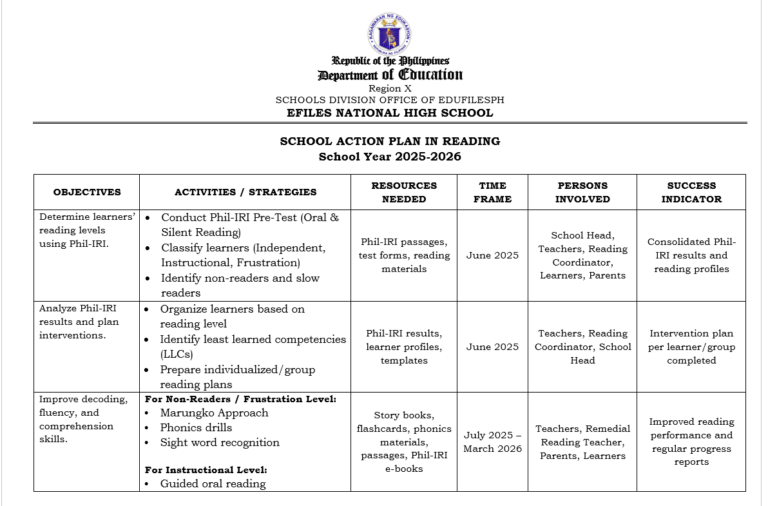
Preview of the File
Below is a preview of the Action Plan in Reading template.
Important Reminder
This Action Plan in Reading template is shared to help teachers and schools prepare reading intervention plans more conveniently. Please review and customize the file based on your school’s reading program, learner assessment results, and actual needs.
If your school, district, or division provides a required format or reading program template, please follow the official format.
If you notice any error, broken link, missing section, or formatting issue, please message or contact EduFilesPH so we can review and update the file when needed.
Please do not repost, resell, or claim this template as your own. You may share the official EduFilesPH post link instead so other teachers can access the original source.
Frequently Asked Questions
Is this Action Plan in Reading free?
Yes. This post provides a free editable Action Plan in Reading template.
What file format is used?
The template is in editable Microsoft Word format.
Is this based on Phil-IRI?
Yes. The template is designed to support reading intervention planning based on Phil-IRI assessment results.
Can I edit the template?
Yes. You may edit the school details, objectives, activities, resources, time frame, persons involved, and success indicators.
Who can use this template?
This template may be used by teachers, reading coordinators, school heads, master teachers, and school reading program teams.
What reading levels are considered in the plan?
The template may be used to plan interventions for learners at different reading levels, including independent, instructional, and frustration levels.
Can I use this for another school year?
Yes. Since the file is editable, you may update the school year and revise the activities based on your current school calendar and reading program.
Can I use this for elementary learners?
Yes. The template is suitable for elementary reading intervention planning and may be customized based on grade level.
Can this be used for school-based reading programs?
Yes. The template can serve as a starting point for school-based or class-based reading intervention planning.
Does this replace the school’s official reading program?
No. This template is only a support resource. Teachers should still follow their school’s official reading program, required format, and instructions.
What should I check before printing or submitting?
Check the school details, objectives, activities, resources, time frame, persons involved, success indicators, signatories, and alignment with your school’s reading program.
Can I share this file with other teachers?
You may share the official EduFilesPH post link. Please do not repost, resell, or claim the template as your own.
Related Resources
You may also check these related EduFilesPH resources:
- PMES Portfolio Templates SY 2025–2026
- Free Editable Communication Log for PMES Objective 12
- Automated Test Result Analysis Template
- Automated SF8 Learner’s Basic Health and Nutrition Report
- School Forms Cover Template
- Summary of Grades Template with Ranking and Awardee Indicator
Download the Free Editable Action Plan in Reading
You may download the editable Action Plan in Reading template using the button below. Please review and customize the file before using it for school planning, reading intervention, or submission.
Available File

Disclaimer
EduFilesPH shares educational templates and resources to help teachers and school personnel. The files are provided as supplementary tools and should be used with proper checking and school guidance.
This Action Plan in Reading template is not an official DepEd-issued file. It is an editable teacher-support resource created to help schools and teachers prepare reading intervention plans more conveniently.
Users are advised to validate all details, activities, timelines, and success indicators according to their school’s official reading program, assessment results, and planning requirements. EduFilesPH is not officially affiliated with the Department of Education unless clearly stated. Always refer to official school instructions, reading program guidelines, and division or regional directions when preparing official school documents.