
A School Action Plan in Reading/Literacy for Grades 1–3 helps teachers, reading coordinators, and school personnel organize activities that support early literacy, reading readiness, vocabulary development, oral reading, comprehension, and learner progress monitoring.
For SY 2026–2027, teachers handling Grades 1–3 may need an editable action plan that can guide classroom-based reading activities, intervention sessions, reading remediation, enrichment tasks, CRLA-related follow-up, ARAL Reading support, and documentation.
This editable Reading/Literacy Action Plan is prepared to help teachers save time in planning. It may be used as a guide, but the content should still be reviewed, revised, and customized based on learners’ actual reading needs, grade level, assessment results, school priorities, available materials, and implementation schedule.
Resource Information
Resource Type: School Action Plan
Program Area: Reading / Literacy
Grade Levels: Grades 1–3
School Year: SY 2026–2027
File Format: Editable Word file
Recommended Users: Grades 1–3 teachers, reading teachers, class advisers, reading coordinators, school heads, and school program coordinators
Main Use: Planning early literacy activities, reading intervention, enrichment, monitoring, and documentation
Included Activities: Early literacy, reading readiness, vocabulary, oral reading, comprehension, CRLA-related support, ARAL Reading, and classroom-based reading activities
About This Reading/Literacy Action Plan
The School Action Plan in Reading/Literacy for Grades 1–3 is designed as a ready-to-edit planning guide for teachers who support young learners in developing foundational reading skills. It provides a structured format for organizing objectives, activities, timelines, persons involved, expected outputs, resources needed, success indicators, and monitoring strategies.
This template may help teachers prepare a more organized plan for early literacy development, reading readiness, word recognition, oral reading practice, vocabulary-building, comprehension activities, and follow-up support for learners who need additional reading assistance.
The action plan should not be submitted without review. Teachers are encouraged to revise the content based on actual learner data, classroom observations, reading assessment results, school calendar, and available resources.
Why This Reading/Literacy Action Plan May Be Useful
Reading and literacy development in Grades 1–3 is important because learners are still building foundational skills needed for understanding texts, following instructions, expressing ideas, and learning across different subjects.
A clear Reading/Literacy action plan may help teachers:
- organize early literacy activities for the school year;
- identify learners who need reading support;
- plan reading remediation and enrichment activities;
- strengthen vocabulary, oral reading, and comprehension skills;
- support CRLA-related reading follow-up activities;
- include ARAL Reading-related support when applicable;
- monitor learner participation and progress;
- prepare documentation for reports and MOVs; and
- align reading activities with the school calendar and learner needs.
What’s Included in the Template?
The editable Reading/Literacy Action Plan may include the following parts:
- title of the action plan;
- school year and grade coverage;
- rationale or brief background;
- general and specific objectives;
- target learners or participants;
- reading assessment basis;
- proposed reading activities and strategies;
- three-term implementation timeline;
- persons involved;
- resources needed;
- expected outputs;
- success indicators;
- monitoring and evaluation section; and
- remarks or documentation notes.
Suggested Activities for Reading/Literacy
The activities in the template may be edited depending on the grade level, learner needs, reading assessment results, available materials, and school context. Some possible Reading/Literacy activities include:
- checking of learners’ reading readiness and literacy needs;
- review of CRLA results or available reading records;
- identification of learners needing reading support;
- grouping of learners based on reading needs;
- letter sound and word recognition activities;
- vocabulary-building activities;
- guided oral reading sessions;
- storytelling and picture reading;
- shared reading activities;
- teacher-guided reading remediation;
- peer reading or buddy reading activities;
- repeated reading practice;
- sentence and short paragraph reading;
- comprehension questions after reading;
- use of reading corners or classroom reading routines;
- home reading practice with parent support;
- ARAL Reading-related intervention activities when applicable;
- monitoring of learner reading progress; and
- preparation of documentation and accomplishment reports.
Three-Term Implementation Guide
This action plan may be adjusted depending on the school calendar and actual implementation schedule. Below is a simple guide for organizing Reading/Literacy activities across three terms.
Term 1: Reading Assessment, Grouping, and Initial Support
During the first term, teachers may focus on checking learners’ reading readiness, reviewing available reading data, identifying learners who need support, and starting initial intervention activities.
Possible Term 1 activities may include:
- checking of CRLA results or available reading assessment data;
- identification of learners needing reading support;
- grouping of learners based on reading needs;
- preparation of reading intervention list;
- orientation of learners and parents about reading support activities;
- initial vocabulary and word recognition activities;
- guided oral reading sessions; and
- documentation of baseline information.
Term 2: Continued Reading Intervention and Practice
During the second term, teachers may continue reading intervention activities and provide regular practice to improve word recognition, oral reading, vocabulary, and comprehension.
Possible Term 2 activities may include:
- regular guided reading sessions;
- storytelling and picture reading activities;
- repeated reading practice;
- vocabulary-building exercises;
- short sentence and paragraph reading;
- comprehension checks after reading;
- peer reading or buddy reading;
- home reading practice with parent support;
- monitoring of learner participation; and
- documentation of reading progress.
Term 3: Progress Checking, Enrichment, and Reporting
During the third term, teachers may focus on checking learner progress, providing follow-up support, conducting enrichment activities, and preparing documentation.
Possible Term 3 activities may include:
- follow-up reading checks;
- review of learner improvement;
- enrichment activities for progressing learners;
- continued support for learners who still need remediation;
- reading output presentation when applicable;
- preparation of reading intervention documentation;
- accomplishment report preparation; and
- recommendations for continued reading support.
How to Use This Template
- Download the editable file from the download section.
- Open the file using Microsoft Word or any compatible document editor.
- Review the sample content carefully before editing.
- Replace the school name, grade level, dates, names, and other sample details.
- Check your learners’ actual reading needs using available reading data.
- Review CRLA results, classroom observations, reading records, or other available assessment information.
- Revise the objectives based on learner needs and school priorities.
- Edit the activities based on your school calendar and available reading materials.
- Adjust the timeline according to the three-term schedule or actual implementation plan.
- Check the expected outputs, success indicators, and monitoring activities.
- Proofread the final version before printing, submitting, or sharing.
Teacher Tip
Use this template as a guide, not as a final document. A good Reading/Literacy action plan should begin with actual learner data.
Before finalizing the file, review learners’ reading readiness, word recognition, oral reading fluency, comprehension, participation, attendance, and parent support. These details can help make the action plan more realistic and useful for Grades 1–3 learners.
Preview of the File
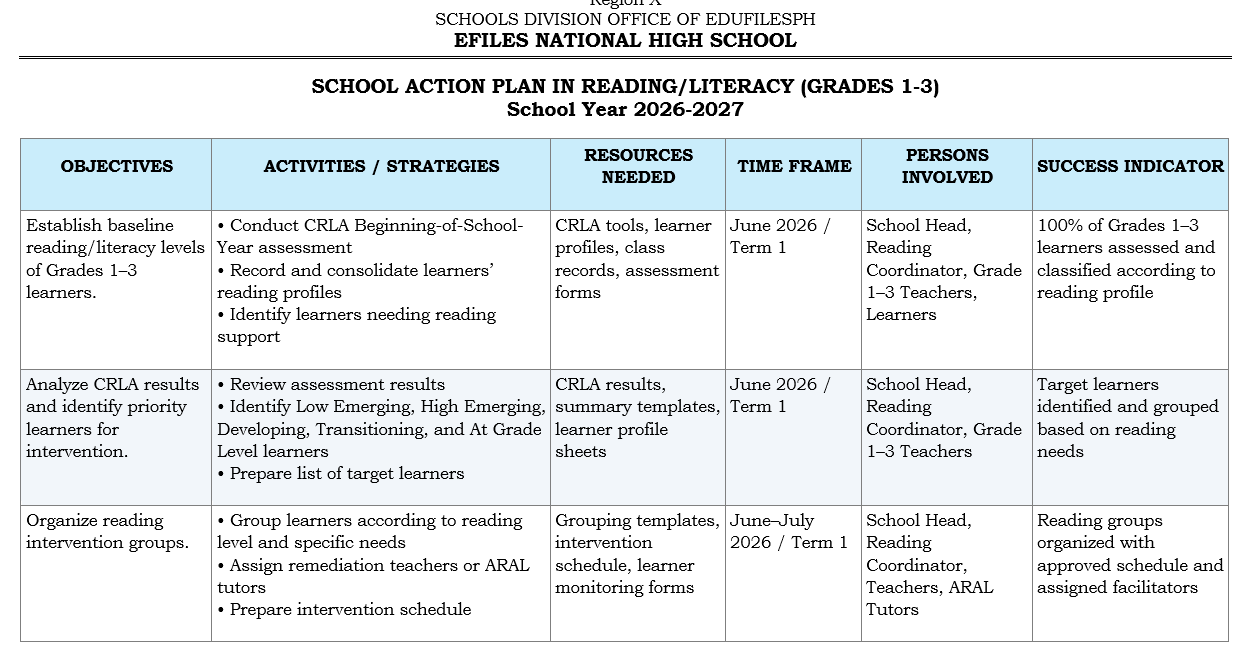
Below is a preview of the editable Reading/Literacy Action Plan for Grades 1–3. The actual file may contain additional sections, tables, or editable parts depending on the final version provided.
Important Reminder
This Reading/Literacy Action Plan for Grades 1–3 is shared to help teachers save time in preparing reading intervention plans and related documents. Please review, edit, and customize the file before using it.
Do not submit the template without checking the learner data, objectives, activities, timeline, persons involved, expected outputs, and success indicators. Make sure the final version matches your actual school context, reading program, and learner needs.
Please do not repost, resell, or claim this file as your own. You may share the official EduFilesPH post link instead so other teachers can access the original source.
Frequently Asked Questions
Is this Reading/Literacy Action Plan editable?
Yes. The file is editable and may be revised based on your school context, grade level, learner needs, reading assessment results, and implementation schedule.
Can this be used for Grades 1–3?
Yes. This template is prepared for Grades 1–3. However, teachers should adjust the activities based on the learners’ age, grade level, reading readiness, and actual needs.
Can I use this for SY 2026–2027?
Yes. The template is prepared for SY 2026–2027. Please review the dates, activities, and timeline before using it.
Is this action plan ready for submission?
No. This is a template and sample guide only. Teachers should customize the content before submitting it to the school head, reading coordinator, department head, or concerned office.
Can I use this with CRLA results?
Yes. The template may be used as a guide for planning reading support activities based on CRLA results or other available reading assessment data.
Can I include ARAL Reading activities?
Yes. You may include ARAL Reading-related support, remediation activities, enrichment tasks, and monitoring activities depending on your school’s implementation plan.
Can I add my own reading activities?
Yes. You may add, remove, or revise activities depending on your learners’ reading needs, available materials, school calendar, and reading program priorities.
Can I share this file with other teachers?
You may share the official EduFilesPH post link. Please do not repost, resell, or claim the file as your own.
Related Resources
You may also check these related EduFilesPH action plan resources:
- School Action Plans SY 2026–2027
- Phil-IRI Reading Action Plan for Grades 4–10
- Free Action Plan in Reading Filipino Phil-IRI Based SY 2026–2027
- Free Editable CRLA-Based School Action Plan in Reading
- School Action Plan in Filipino SY 2026–2027
- School Action Plan in English SY 2026–2027
Download the Reading/Literacy Action Plan
You may download the editable Reading/Literacy Action Plan for Grades 1–3 for SY 2026–2027 using the button below. Please make sure to review and customize the file before using it in your school.

Disclaimer
EduFilesPH shares educational templates and resources to help teachers and school personnel. The files are provided as editable guides and should be reviewed and customized before use.
EduFilesPH is not officially affiliated with the Department of Education unless clearly stated. Always refer to official DepEd issuances, school instructions, reading program guidelines, curriculum guides, and division or regional instructions when preparing official documents.